

- Published:
- Monday 5 October 2026 at 9:00 am
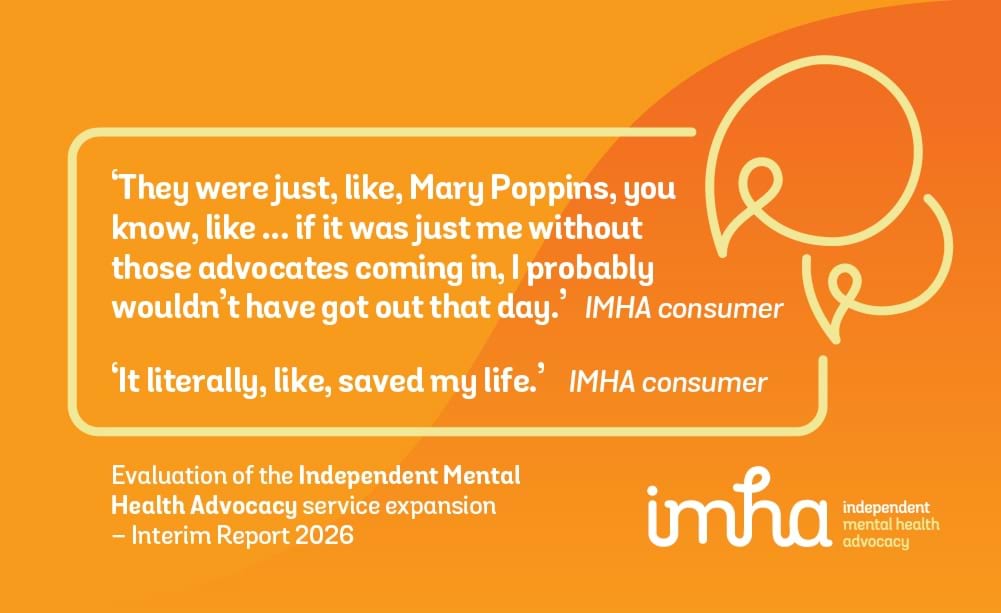
An interim evaluation of Independent Mental Health Advocacy (IMHA) reveals the positive impact the service is having, with consumers endorsing it as ‘independent’ and ‘trustworthy’.
Since September 2023, IMHA is automatically notified when someone is placed on a compulsory mental health treatment order or experiences restrictive interventions such as seclusion in Victoria. An advocate then reaches out to the individual to offer support unless they have chosen not to be contacted.
This ‘opt-out’ model has seen a significant increase in the number of people accessing IMHA’s services, including many who would not normally ask for help, according to the interim results of an evaluation of IMHA’s expansion by La Trobe University alongside RMIT University and independent lived experience consultants.
The interim report reveals that IMHA’s opt-out model is the primary driver of improved access to the service by people on compulsory treatment orders.
Across the two-year evaluation period, IMHA received 105,077 notifications relating to 17,276 individuals and provided service to 13,267 individuals.
Download the full report
Email us at contact@imha.vic.gov.au if you need this information in a more accessible format, such as large print or audio.
The report also recognised the successful implementation of other elements of IMHA’s expansion, including the First Peoples and Child and Youth advocates, as well as new legislative powers.
Overall, it said, the expansion has been well received by consumers and appears to be achieving its goals.
The interim evaluation was based on interviews and focus groups with 35 consumers and around 100 staff across partner organisations, an online survey completed or partially completed by 88 consumers, consultation with selected external stakeholders and analysis of routinely collected service data.
One consumer said, ‘They were a knight in shining armour. I mean, (advocate) was the white horse, and IMHA were the knight in shining armour, because without them, it would have been a much different situation.’
‘I would go as far to say it literally, like, saved my life,’ said another consumer. ‘When you are locked up in a room and you are not told how long it's going to be before you get out and you can't contact your family, to ... find out that there's someone who's talking on your behalf and advocating for you is … is the only lifeline.'
IMHA Associate Director Helen Makregiorgos said the results were important given the trust invested in the service by people with lived experience.
‘The interim evaluation shows the enormous impact IMHA is having on the lives of people faced with compulsory treatment in Victoria,' she said.
'We are proud to walk alongside consumers during incredibly challenging times in their lives.
‘While it is pleasing to be told our work is making a difference, there is still much work to do to improve our mental health and wellbeing system so that it centres rights, supported decision-making and recovery.’
One stakeholder said, ‘Opt-out, to me, is the best thing that's ever happened to this system, and it's allowed people to have the opportunity to have a voice and to be heard.’
An IMHA staff member said, ‘We're having a lot more conversations with First Peoples consumers. They (are) actually identifying, whereas in the past they may not have or (are) still not identifying as Aboriginal to the hospital services until an advocate (asked them).’
Recommendations from the interim evaluation
The report’s preliminary recommendations included continuing to implement and embed IMHA’s opt-out approach, improving timeliness of notifications and further strengthening referral processes to the Mental Health Legal Rights Service (MHLRS) to continue to support access to legal assistance.
The evaluation also identified 3 operational risks that require early action to protect the integrity of the opt-out model:
- Notification timeliness is poor for some notification types with an average delay of up to 10 days caused by mental health services entering data after the event has concluded. This restricted access to advocacy until after the time it was needed most.
- There are persistent barriers to consumer contact, including missing or incorrect contact details, making it difficult to contact and assist consumers.
- Under-reporting from outside specialist mental health units, such as hospital emergency and other wards using the Mental Health and Wellbeing Act 2022 (Vic) was concerning. Staff reported that notifications for some cohorts, particularly children and young people, were not being made in accordance with the Act.
The findings are consistent with IMHA’s recent two-year report on the opt-out model, released in June this year.
La Trobe’s interim report will provide a baseline reference point for the final stage of the evaluation, due in 2027.
The evaluation will also consider the MHLRS, a co-designed legal service being implemented in partnership by Victoria Legal Aid, the Mental Health Legal Centre and the Victorian Aboriginal Legal Service.
Updated